Build Guide
Carpentry Hardware in Singapore — The Part of the Quote That Decides How Long It Lasts
Two carpentry quotes can look identical on doors and worktop and be thousands apart on hardware. Hardware is what fails first — and it is the line item nobody compares.
20 August 2026 · 9 min read · Updated 20 August 2026
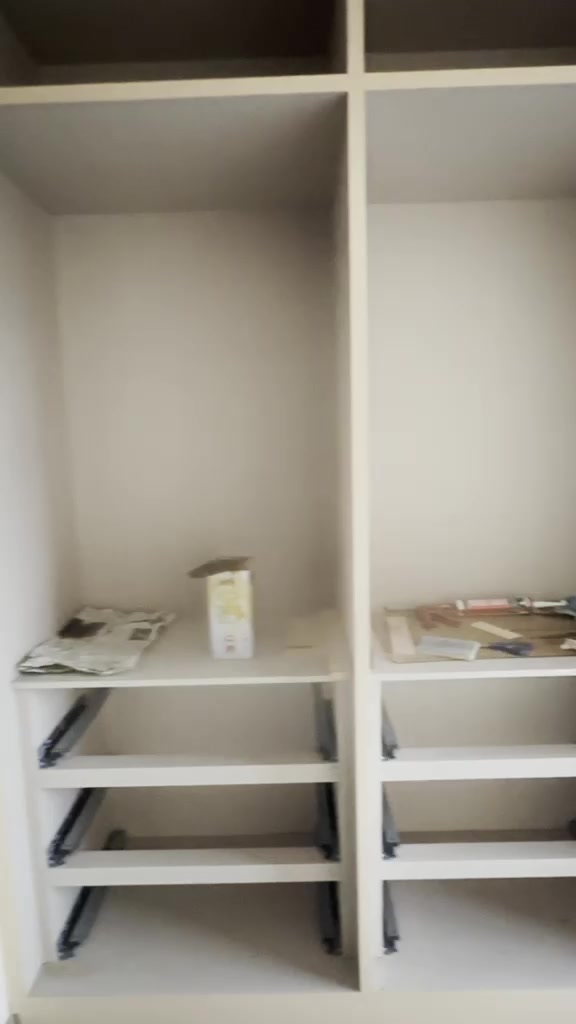
Interior of a wardrobe carcass with black full-extension soft-close drawer runners fitted to both bays
Put two carpentry quotes side by side and most people compare the same things: laminate, worktop, number of doors, total price. Almost nobody compares hardware.
Hardware is what fails. Laminate does not wear out in ten years. A cheap drawer runner starts catching in twelve months.
The short version
| Component | Skimp? | Typical upgrade cost | Why it matters |
|---|---|---|---|
| Drawer runners | Never | S$25–S$60 per drawer | Carries full load every cycle; first thing to fail |
| Hinges | No | S$8–S$20 per door | Cheap hinges sag; doors stop aligning |
| Pull-out baskets | Optional | S$120–S$350 each | Turns deep base units into usable storage |
| Locks | Only if needed | S$25–S$60 each | Must be designed in, not retrofitted |
| Handles / profiles | Yes, safely | Varies widely | Cosmetic, and genuinely replaceable later |
The pattern: spend on moving parts, save on decorative parts. Handles can be swapped in an afternoon. Runners cannot.
Drawer runners
The most important hardware in your flat, and the least discussed.
Every time a drawer opens, its runners carry everything inside it. A kitchen drawer of pots, a wardrobe drawer of folded clothes — that is real weight, moving on a cantilever, several thousand times over the life of the flat.
Full extension vs partial extension. A partial-extension runner pulls out about three-quarters of the drawer depth. The back stays in the cabinet. On a 550mm drawer that is roughly 130–150mm of storage you own but cannot comfortably reach — you end up storing things there you have forgotten about. Full extension brings the whole drawer clear.
Soft-close. A damper that catches the last few centimetres so the drawer closes quietly instead of slamming. It is not only comfort: slamming is what loosens drawer fronts and wears the mechanism over years.
Undermount vs side-mount. Undermount runners sit beneath the drawer box, hidden, and give a cleaner look with slightly more internal width. Side-mount runners are visible on the drawer sides and cheaper. Both work; undermount is the premium option.
Load rating. Runners are rated — commonly 30kg, 40kg, 50kg. A wardrobe drawer of clothes is lighter than it looks; a kitchen drawer of pans is heavier. Deep or wide drawers should be specified accordingly.
In the Bidadari BTO build, runners went into the wardrobe carcasses in the workshop, before delivery — so every drawer was tested and adjusted before anything reached the flat.
Hinges
Less critical than runners, still worth getting right.
Modern cabinet hinges are concealed European-style, adjustable in three directions after fitting. That adjustability is the point: a door that drifts out of alignment as the flat settles can be trued up with a screwdriver rather than rebuilt.
Look for soft-close (usually integrated now), clip-on mounting so a door can be removed and refitted without losing adjustment, and the correct opening angle — a standard 110° hinge is fine for most doors, but a cabinet in a corner or beside a wall may need 155° to open clear.
Cheap hinges sag under a tall or heavy door. Once the door line goes out across a run of wardrobes, it is visible from across the room and irritating forever.
Locks
Uncommon, occasionally essential. A keyed barrel lock in a drawer or door is worth specifying if you share the flat, have helpers or tenants, or simply want documents and spare keys secured.
The thing to know: it has to be planned in. The lock body needs clearance behind the drawer front, and the strike needs solid material to catch into. Retrofitting to a finished drawer is possible but rarely as clean as building it in.
Pull-outs and baskets
A deep base cabinet with a fixed shelf is bad storage. You crouch, you reach past whatever is at the front, you cannot see the back. Most people end up using only the front third.
A pull-out brings the whole contents to you. In a Singapore kitchen where base cabinets do most of the work, that is a genuine daily difference. Costs roughly S$120–S$350 per pull-out.
Worth doing under the sink too, where the plumbing usually makes the space unusable — a U-shaped pull-out works around the trap.
Handles: where you can safely save
Handles are the one place to relax. They are cosmetic, they are not load-bearing in any meaningful sense, and they can be changed later in an afternoon with a screwdriver.
The exception is handleless, which is not a handle at all but a profile machined into the door edge or a J-shaped section. That is carpentry, not hardware, and it does cost more — the profile has to run true across the entire door line, and any inconsistency is immediately visible. The Bidadari kitchen used this, and in a narrow galley the payoff is real: nothing protrudes to catch clothing as you pass.
Blum, Hettich, and everything else
Both are premium European manufacturers. Blum is the usual benchmark for undermount runners with the widest mechanism range; Hettich is comparable and often a little cheaper in Singapore. Either will outlast the cabinetry around it.
The meaningful distinction is not Blum versus Hettich. It is either of them versus unbranded hardware — which is what fills the gap between two quotes that otherwise look the same.
The question to ask
When comparing quotes, ask:
"Which runners and hinges are you using — brand and model? Are the runners full extension? Is soft-close included or extra?"
A carpenter who specifies good hardware will answer immediately, because it is a selling point. A quote that stays vague about hardware is usually vague for a reason.
That single question does more to explain a price gap than any other you can ask.
Want hardware specified properly?
Every quote we send names the runners and hinges by brand and model. Ask for the breakdown and you will get it.
WhatsApp Alan about your project.
Related: how custom carpentry is made shows where hardware gets fitted in the build sequence; materials guide covers what the hardware is screwed into, which matters just as much.

Written by
Alan Chew
Founder & Master Carpenter · TOKTOKTOK
Alan founded TOKTOKTOK Carpentry Singapore in 2020 and has personally led 200+ HDB, condo, and landed carpentry builds across the island — handling every project from first measurement to final handover. More about Alan →
Ready to build?
Get a real quote for your project.
Share your floor plan and a few reference photos. Real quote in writing within 24 hours, no commitment.