Materials Guide
Plywood vs Blockboard vs MDF — Singapore Carpentry Materials Guide
What every cabinet is made of underneath the laminate, why it matters for Singapore humidity, and which material belongs where in your home.
18 May 2026 · 9 min read · Updated 11 June 2026
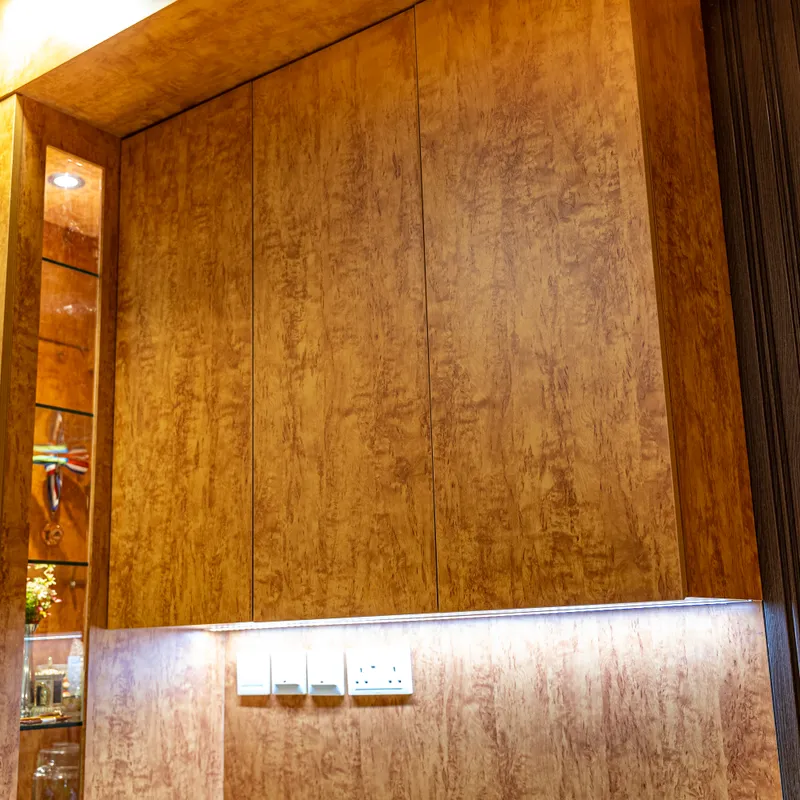
Bookmatched walnut veneer cabinet fronts — the visible face that sits on top of every plywood carcass
Every cabinet in your home is made of two parts: the carcass (the structural box) and the fronts (doors, drawers, what you see). The carcass material determines whether your wardrobe is still square in five years or sagging at the hinges. It's also the part most homeowners never see, never ask about, and never get specified in writing.
This guide is for that question — what's inside the cabinet, why it matters for Singapore, and how to spec it correctly.
The three carcass materials, in plain language
Moisture-resistant plywood (MR ply)
Multiple thin layers of hardwood glued at alternating grain directions. The cross-grain construction resists swelling, holds screws reliably, and survives the humidity cycle Singapore puts furniture through. MR plywood is the default carcass material for any Singapore carpentry that wants to last 15+ years.
The "MR" rating refers to the glue. Standard interior plywood uses urea-formaldehyde glue, which dissolves under prolonged moisture exposure. MR plywood uses phenol-formaldehyde or melamine-formaldehyde glue that holds up to humidity.
Where it belongs: Everywhere. Especially kitchens, bathrooms, balconies, anywhere within 1.5m of a window, and any cabinet on an external wall.
Cost premium over alternatives: ~15–25% more than blockboard, ~40–60% more than MDF.
Blockboard
Solid timber strips edge-glued into a core, with a thin plywood or veneer skin on top and bottom. Lighter than plywood and historically cheaper, with reasonable screw-holding strength when the screw lands in solid wood and poor screw-holding when it lands between strips.
Where it works: Lighter dry-zone applications — TV consoles, study desks, bookshelves in air-conditioned rooms. Acceptable on tight budgets, with edge banding on all four sides.
Where it fails: Anywhere wet, anywhere heavy, and anywhere humidity cycles between wet and dry seasons. Don't put blockboard in a kitchen.
MDF (Medium-Density Fibreboard)
Compressed wood fibres + resin into a dense, uniform sheet. Smooth surface ideal for spray-painted or veneered finishes. MDF is not for carcasses — it's a fronts and shelves material. Treat it that way.
Where it belongs: Painted doors (where you want a flawless seamless finish), shelves under light load, profiled mouldings.
Where it fails: Anywhere it might get wet. MDF swells permanently on contact with water and never returns to its original dimensions. A burst pipe or a leaky pot once is enough to ruin every piece of MDF in the room.
Blockboard vs MDF — the budget head-to-head
If you're comparing these two, you're usually trying to save money against the MR plywood baseline. Here's the direct answer:
Blockboard beats MDF for anything structural; MDF beats blockboard for anything painted. Blockboard (often written "block board") holds screws better, weighs less, and tolerates Singapore's ambient humidity. MDF gives a smoother painted finish but swells permanently the first time it gets wet and sags under sustained load. Use blockboard for light dry-zone structure — TV consoles, study desks, bookshelves in air-conditioned rooms. Use MDF only for door fronts and light shelves. Use neither in a kitchen or bathroom.
| Blockboard | MDF | |
|---|---|---|
| Screw holding | Good when the screw lands in a timber strip; weak between strips | Weak — screws strip easily, worst on panel edges |
| Humidity tolerance | Handles ambient humidity; fails with direct water | Swells permanently on any direct water contact |
| Weight | Light — easier on wall-hung units | Heavy — dense fibre throughout |
| Shelf sag under load | Acceptable at moderate spans | Sags over time beyond ~600mm spans |
| Painted finish | Strip lines can telegraph through thin paint | Flawless — the best painted-finish substrate |
| Cost (sheet for sheet) | Slightly more than MDF | Cheapest of the three |
| Lifespan in Singapore | 5–10 years in dry zones | 3–7 years, less with any wet exposure |
When blockboard wins: a study desk, a bookshelf, a TV console in an air-conditioned room — anywhere you need a light structural box on a budget and the screws need to hold.
When MDF wins: spray-painted door fronts where you want a seamless single-piece look, decorative wall panelling, light display shelves. As a fronts material on top of a plywood carcass, MDF is legitimate — that's the "mixed" spec in the cost table below.
When neither wins: kitchens, bathrooms, balcony storage, anything within 1.5m of a window. And if your budget stretches 15–25% above blockboard pricing, MR plywood outlasts both by a decade — see the cost table further down.
The Singapore-specific reality
Singapore is 75–85% humidity year-round, with monsoon spikes above 90%. That's enough to:
- Swell low-grade plywood at exposed edges (any cut edge that isn't banded)
- Delaminate blockboard at the skin if the skin's glue is interior-grade
- Permanently warp MDF if a single drop of water sits on it for an hour
This is why almost every reputable Singapore workshop defaults to MR plywood for carcasses, regardless of where the cabinet is going. The cost premium is small, the failure modes for the alternatives are catastrophic, and most carpentry warranties exclude moisture damage to non-MR materials.
If your quote specifies "high-quality plywood" or "engineered timber" without specifying MR rating, ask which grade. If the answer is anything other than MR (moisture-resistant) or marine-grade, request a written substitution to MR plywood and a re-priced quote.
What about "engineered wood" or "compact board"?
Two terms that get used loosely in Singapore carpentry quotes:
- "Engineered wood" is a catch-all that can mean MR plywood, regular plywood, blockboard, or MDF. It tells you nothing useful. Ask for the specific name.
- "Compact board" / "phenolic board" is a high-density laminate used in commercial wet areas (toilet cubicles, lab benches). Genuinely waterproof but expensive (~3–4x the price of MR plywood for the same panel). Overkill for residential cabinetry except in very specific wet applications like outdoor kitchen carcasses or wet-zone bathroom vanities.
Thickness specs that matter
Material is one variable. Thickness is the other. Industry baseline for Singapore residential carpentry:
- Carcass sides and bottom: 18mm
- Back panel: 9mm (sometimes 6mm on cheaper builds — sags over time)
- Shelves (under 800mm wide): 18mm
- Shelves (over 800mm wide): 25mm, or 18mm with a centre support
- Door fronts: 18mm
Some workshops cut cost by going to 15mm or 12mm carcasses. These flex visibly under load, develop hinge sag in 2–3 years, and don't hold full-extension drawer runners reliably. Ask for the carcass thickness in writing on your quote.
Cost comparison (4-room HDB carpentry, illustrative)
Same scope built three ways:
| Material spec | Approx. cost | Expected lifespan |
|---|---|---|
| MR plywood throughout (industry baseline) | S$18,000 | 15–20 years |
| Mixed: MR plywood carcass + MDF doors | S$16,500 | 15–20 years |
| Blockboard carcass, MDF doors (budget) | S$13,500 | 5–10 years |
| MDF throughout (avoid) | S$10,000 | 3–7 years |
The S$4,500 saved on the budget spec is more than spent on a partial re-do in year 7.
How to specify materials on your quote
When you receive a quote, the materials section should read something like:
Carcass: 18mm moisture-resistant plywood (MR Ply), edge-banded on all four sides with hot-melt PVC. Back panel: 9mm MR Ply. Shelves: 18mm MR Ply with hot-melt PVC edge banding. Door fronts: 18mm laminate-faced MDF, hot-melt PVC edge banding. Drawer boxes: Blum Tandembox white steel.
If the materials section is shorter than that, push back. Vague specs leave room for substitution.
What to ask your carpenter
Six questions that surface the material reality fast:
- "Is the carcass MR plywood throughout, including the back?"
- "What thickness is the carcass, and what thickness is the back?"
- "Is every cut edge banded with hot-melt PVC, or pre-glued iron-on?"
- "What's the screw spec for hinge mounting — euro screws, confirmat, or self-tapping into the plywood directly?"
- "Where is the material sourced and what's the brand or mill?"
- "What does the workmanship warranty cover for moisture damage?"
A carpenter who answers all six clearly is one you can work with. A carpenter who answers vaguely or pivots to "don't worry, we use only the best" is a carpenter who will substitute on the day.
Where to go from here
The carcass material conversation should happen at site visit, before the quote is issued — not after. Bring this question list. The right carpenter welcomes the conversation.
If you're collecting quotes now and want a benchmark, WhatsApp Alan with your floor plan — site visit is free, materials are spelled out by name on every quote, and there's no commitment.
For the visible-surface side of the conversation — what to pick for door fronts (laminate, PET, lacquer, veneer) — see choosing laminate for kitchen cabinets in Singapore's humidity. For the broader cost context, read the HDB 4-room renovation cost breakdown or the BTO carpentry timeline guide.
For a project showcasing how carcass + veneer + accent panels come together, see the Toh Tuck Road multi-room carpentry build — cream matte fronts, glass display, stone counters. For one-off pieces (shoe cabinets, study desks, custom dining tables), see our custom furniture service.

Written by
Alan Chew
Founder & Master Carpenter · TOKTOKTOK
Alan founded TOKTOKTOK Carpentry Singapore in 2020 and has personally led 200+ HDB, condo, and landed carpentry builds across the island — handling every project from first measurement to final handover. More about Alan →
Ready to build?
Get a real quote for your project.
Share your floor plan and a few reference photos. Real quote in writing within 24 hours, no commitment.