Buyer's Guide
Carpentry Deposit Structure Singapore — How Payments Should Be Staged
Singapore carpentry deposits range from 50/50 to 70/30. Which is right depends on the workshop, the project, and what you value — leverage or simplicity. Here's how to read either.
19 May 2026 · 6 min read · Updated 1 June 2026
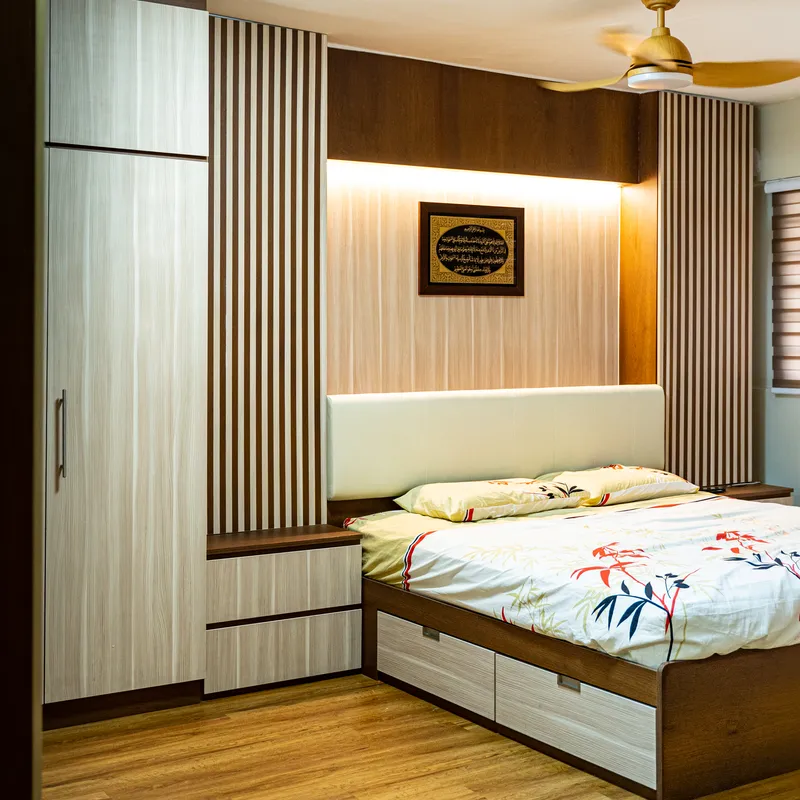
Master bedroom carpentry in a 4-room HDB — wardrobe, fluted feature wall, storage bed
The deposit conversation is where Singapore carpenters separate themselves from the scams and the cowboys. A reasonable deposit structure protects both sides; a genuinely bad one transfers all the risk to you. But "reasonable" covers a wider range than most homeowners realise — the two most common variants in Singapore look quite different from each other, and both are legitimate.
This guide explains what's normal, what's negotiable, and what should make you walk away.
The two common structures
Most Singapore carpentry workshops run one of these two payment patterns:
Variant A — 50 / 50 (on design / on completion)
- 50% deposit on confirmation of design and 3D mock-up sign-off
- 50% balance on completion of installation and handover
The customer holds the second 50% as leverage right up to the moment they sign off on quality at handover. Common at larger workshops that can carry working capital, and with customers who prioritise withheld leverage.
Variant B — 70 / 30 (on design / before install)
- 70% deposit on confirmation of design and 3D mock-up sign-off
- 30% balance before installation begins
The 30% balance is the trigger for delivery and on-site install. By the time the install team arrives at your flat, the project is fully paid. Handover is a quality walk-through, not a payment moment. Common at owner-operated workshops and on projects where materials cost runs high — fronts in veneer or solid wood, specialty hardware lead times.
Both are legitimate. Neither is "the right answer." The trade-offs are real and worth thinking through.
Trade-offs between the two
| Factor | 50 / 50 | 70 / 30 (before install) |
|---|---|---|
| Customer leverage at handover | High (50% withheld) | None (already paid in full) |
| Cash-flow friendly for workshop | No | Yes |
| Handover dynamics | Negotiation moment if defects found | Pure quality check; defects covered by warranty |
| Workshop response to late changes | Possible mid-project — they're not fully committed yet | Locked in earlier — workshop already deep in materials |
| Risk profile for the customer | Lower upfront cash, higher residual leverage | Higher upfront cash, leverage shifts to warranty |
| Typical fit | Standard projects, mid/large workshops | Owner-operated workshops, specialty materials, owners who prefer one final number rather than negotiated handover |
If you value the right to negotiate at handover ("the drawer slide is sticky, fix it before I pay"), Variant A suits you. If you'd rather have one number locked in and treat handover as a no-friction quality check covered by warranty, Variant B suits you.
The leverage question is mostly theoretical for reputable workshops — both variants come with a 12-month workmanship warranty, so defects get fixed regardless of when the final cheque clears. The real difference is the feeling at handover.
What's outside the reasonable range
Walk away from any quote that does any of the following:
"100% upfront before fabrication starts"
This is the scam pattern. Once paid in full at the start, the workshop has no incentive to finish on schedule or fix defects. Legitimate workshops don't operate this way regardless of variant.
"Cash only, to a personal account"
A registered Singapore business — sole proprietor or Pte Ltd — has a corporate bank account and issues invoices. Cash-to-personal-account is a sign of either tax avoidance (their problem) or that the business isn't registered (your problem — no recourse if disputes arise).
Always pay to a registered company account, against an issued invoice. PayNow to the company UEN works. Bank transfer with the workshop's company name in the recipient works. Cash in an envelope to someone's IC name does not.
Multiple "deposits" before fabrication starts
Some quotes split the upfront into "design fee," "measurement fee," "fabrication start fee" — three or four payments before any wood is cut. This obscures how much you're actually paying upfront. Add them all together. If they exceed your variant's first payment (50% or 70%), push back.
No written invoice or receipt
Every payment should generate an invoice (issued by the workshop, listing the work and amount) and a receipt (confirming you paid). If a workshop refuses to issue these, walk away — both for tax reasons (your problem if audited) and for dispute reasons (no paper trail = no recourse).
Asking for the deposit before 3D drawings are produced
Some workshops ask for a deposit immediately after the quote, before any 3D mock-up exists. Push back. The 3D is part of what the deposit pays for; without it, you're paying before you've seen what you're getting. The deposit should follow the 3D sign-off, not precede it.
Demanding the full payment before delivery in Variant A territory
If a workshop pitched 50/50 and then asks for 100% before delivery, the goalposts have moved. They're either telling you they switched to Variant B without warning, or they're trying to capture full payment with no withheld leverage. Either way, get the change in writing or walk.
What reasonable carpenters say
When a carpenter explains their deposit structure, you should hear something like this:
Variant A: "50% on confirmation of design after the 3D mock-up. We use that to buy materials and start fabrication. Balance 50% on completion when you've walked through and confirmed everything works. Both payments by bank transfer to our registered company account, you'll get an invoice for each."
Variant B: "70% on confirmation of design after the 3D mock-up — covers materials, hardware, and starts fabrication. Balance 30% paid in the week before installation; that triggers delivery and on-site work. By the time we walk you through the finished install, the project is fully paid. Both payments by bank transfer to our registered company account, you'll get an invoice for each."
That's the script. What you're listening for: clear payment triggers, registered company account, written invoices, and a specific reason if they ask for more than 70% upfront.
What if my project is large?
For larger projects (full-flat condo, landed homes) running into S$30,000+, some workshops offer or accept three-stage payments:
- 30% deposit on design confirmation
- 30% on fabrication completion (before delivery)
- 40% on installation start or completion (depends on workshop)
This splits your risk into three smaller chunks. It's slightly more administrative for both sides but reasonable. Some customers prefer it for cash-flow reasons; some workshops prefer it because the middle payment funds the next phase. If your project is over S$30,000 and the workshop's standard variant doesn't suit, three-stage is worth asking about.
How to protect yourself further
A few small habits that take five minutes each and save real money if anything goes wrong:
-
Save the company UEN. Every Singapore registered business has a UEN (Unique Entity Number). Look it up at https://www.bizfile.gov.sg/ngbbizfileinternet — confirms the company is active and gives you the registered address. Free.
-
Pay in a way that leaves a record. PayNow to the company UEN or bank transfer to a corporate account. Both create timestamped, traceable records. Avoid cash for anything over S$500.
-
Get the deposit terms in the quote, not just verbally. The exact structure — "70% on 3D mock-up sign-off, 30% before installation begins" — should appear on the written quote. If a verbal agreement is followed by a different written quote, the written version is what counts.
-
Don't pay until 3D is approved. Whether 50/50 or 70/30, the first payment follows the 3D sign-off. Paying earlier means paying before you've seen what you're getting.
-
Confirm the warranty covers defects — 12 months of full workmanship warranty after handover means defects get fixed regardless of which variant you used. Make sure this is on the quote in writing.
What TOKTOKTOK does
For full transparency, here's our policy:
- 70% deposit when you've signed off on the 3D mock-up. Paid by bank transfer or PayNow to our registered company account; invoice issued same day. This pays for materials, hardware, and starts fabrication.
- 30% balance in the week before installation. Paid the same way, second invoice issued. This payment triggers delivery and on-site install.
- No cash payments, no personal accounts, no exceptions.
- 12-month full workmanship warranty from handover — defects get fixed at our cost, regardless of when the payments cleared.
- For projects over S$30,000 — we'll discuss three-stage payments if you'd prefer that cash-flow pattern. Same total, different schedule.
Why 70/30 instead of 50/50? Two reasons. First, we're owner-operated and the materials side of larger HDB and condo jobs runs to a meaningful share of the project cost — we'd rather have those funded than carry working capital. Second, we'd rather treat handover as a pure quality check covered by warranty than as a payment negotiation. The 12-month warranty does the customer-protection work that the withheld 50% does in Variant A, without the friction.
If you'd prefer 50/50, tell us at quote stage and we'll see if the project allows it — usually possible on smaller or simpler scopes.
Where to go from here
If you're reviewing quotes right now and want a second pair of eyes on the deposit structure, send screenshots or photos of the relevant section on WhatsApp. No charge, no pitch — we'll tell you whether what you're being shown is normal.
For broader context on what a fair quote looks like end-to-end, see the HDB kitchen cabinet cost guide or the pricing page for indicative ranges.

Written by
Alan Chew
Founder & Master Carpenter · TOKTOKTOK
Alan founded TOKTOKTOK Carpentry Singapore in 2020 and has personally led 200+ HDB, condo, and landed carpentry builds across the island — handling every project from first measurement to final handover. More about Alan →
Ready to build?
Get a real quote for your project.
Share your floor plan and a few reference photos. Real quote in writing within 24 hours, no commitment.