Landed · Toh Tuck Road
Toh Tuck Road — Restrained Multi-Room Carpentry in Cream, Stone & Black
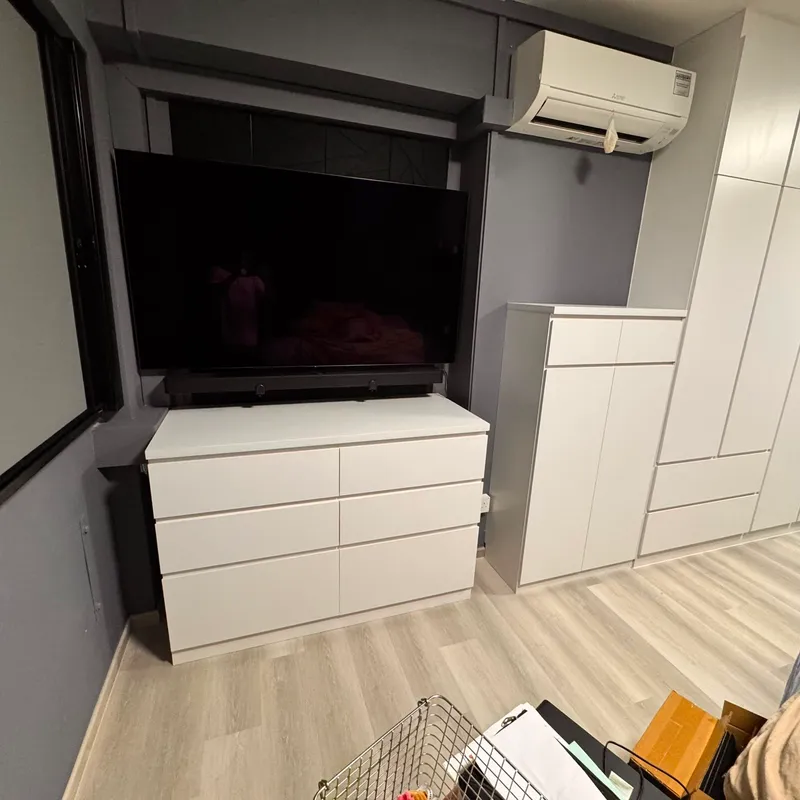
Cream matte fronts on every fitted piece. Black-framed metalwork repeating quietly across rooms. Grey stone where it does work. Concealed warm LED where it doesn't compete. A multi-room build held together by the discipline of staying out of its own way.
Multi-room carpentry · Workshop fabrication; multi-room on-site install · Indicative range S$25k–S$45k
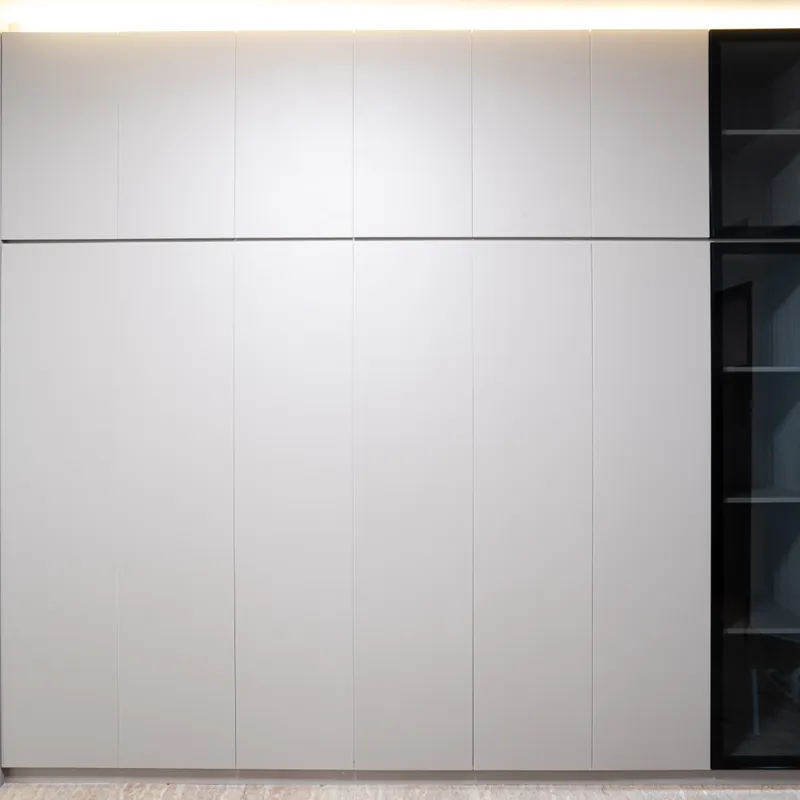
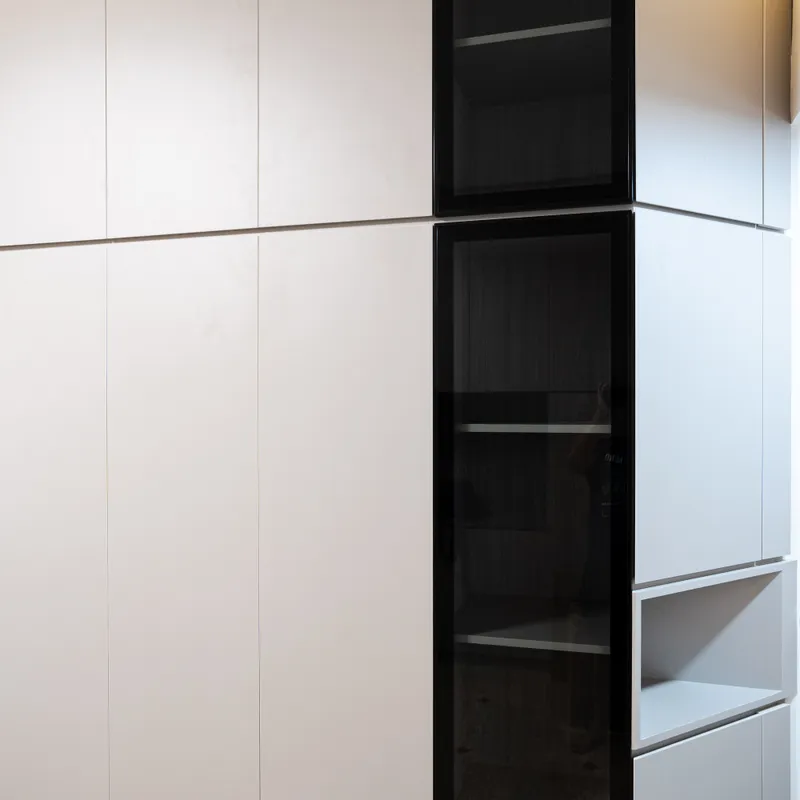
Floor-to-ceiling cream matte wardrobe with integrated black-framed glass display column — Toh Tuck Road residential carpentry
The design idea is restraint. Cream matte laminate on every fitted piece. A single accent vocabulary — black-framed metalwork around glass — repeating quietly across rooms. Grey stone where it does structural work. Concealed warm LED where it doesn't compete with anything.
What holds the build together isn't a single statement piece. It's the discipline of staying out of its own way across multiple rooms — wardrobe, kitchen, study, bedroom feature — so the architecture and the residents' own pieces have room to breathe.
The unifying vocabulary
Three decisions, repeated across every room:
- Cream matte laminate appears on every cabinet face — wardrobe, kitchen, study, bedroom. Single tone, single finish, no variation.
- Black powder-coated steel appears as the frame around two pieces of glass: the vertical display column in the master wardrobe, and the open shelf in the bedroom feature. Same vocabulary, different rooms.
- Selective grey or warm-LED accents introduce the only other materials — grey stone in the kitchen, warm concealed LED in the bedroom.
The result is a build where every room belongs to the same project, even though the rooms do different work.
The master wardrobe
A floor-to-ceiling wardrobe in cream matte laminate, with a slim black-framed glass display tower standing at one side. The frame is dark powder-coated steel; the glass shelves carry a vertical column of useful display — ceramics, books, small collected objects.
The wardrobe itself is restrained — flat cream fronts, finger-pull edges, no visible handles. The glass tower is the variation. Without it, the wall would be too flat; with it, the flat becomes architectural.
The decision to frame the glass in black rather than aluminium or chrome matters. The black sits firmly against the cream — it gives the eye somewhere to land. A polished metal would have asked for attention; the matte black just is.
The kitchen
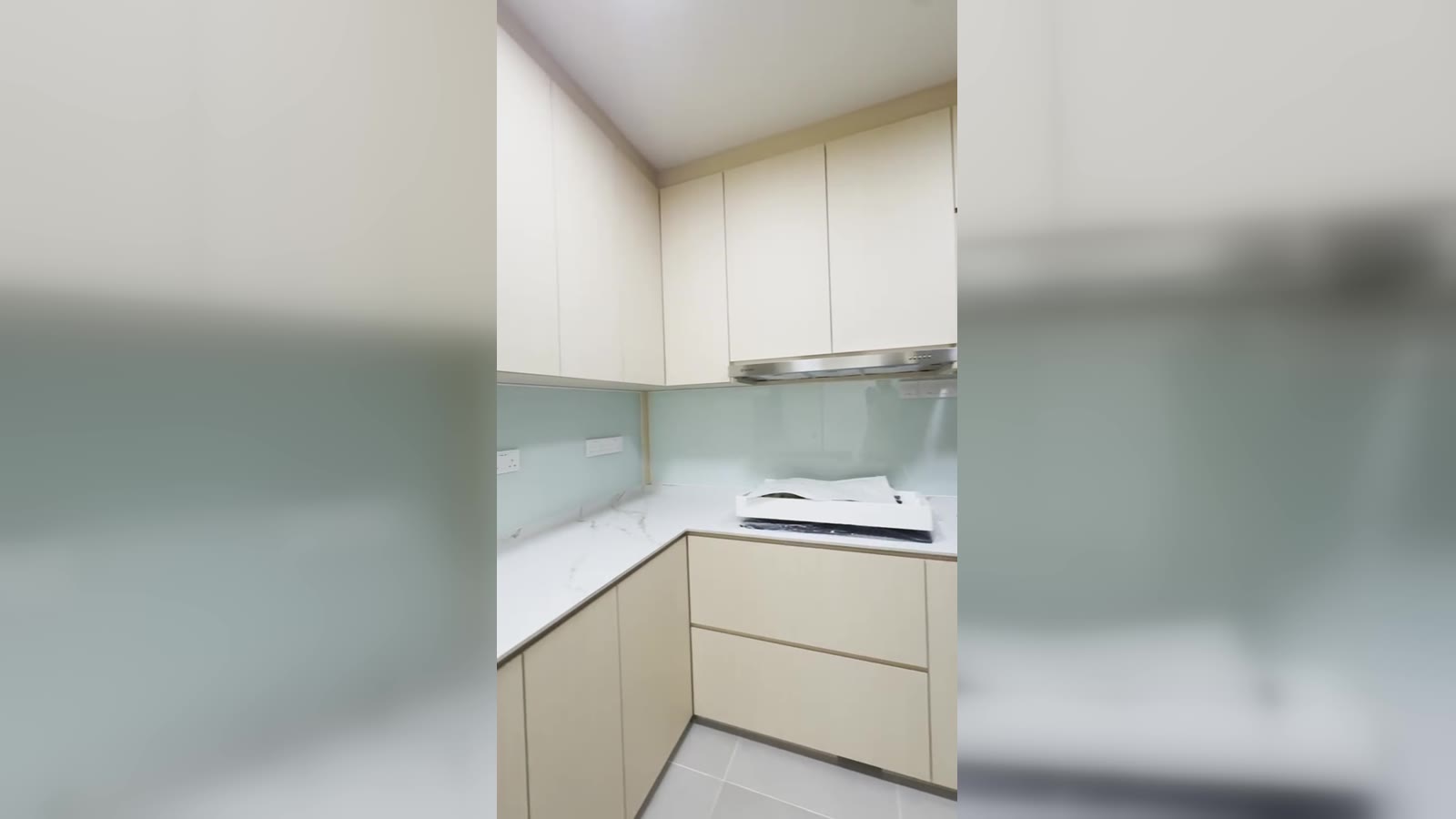
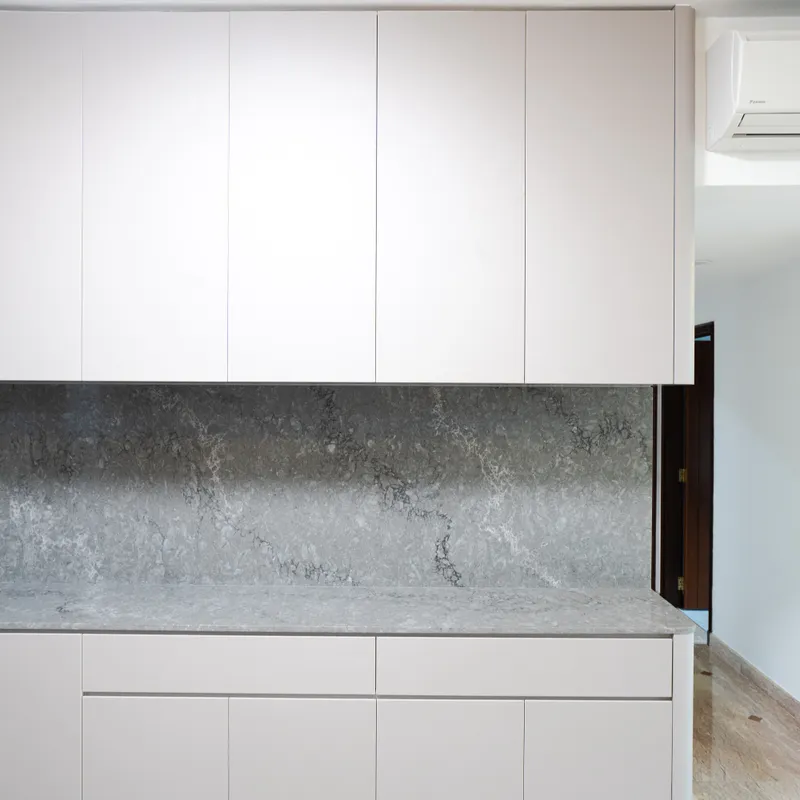
Cream matte uppers and base cabinets, with a grey stone backsplash and matching counter as the visual centre. The stone is textured — visible variation across the slab, not the uniform engineered look — and it's the only patterned surface in the build.
What this does well: it absorbs the visual weight of the cooking zone. A glossy backsplash would have reflected and amplified everything; a printed-pattern tile would have competed. The textured stone does the opposite — it reads as a calm surface, even with the variation in it.
Cabinets sit flush against the stone with the grain of the counter visible at the eye-line. The match is clearly site-confirmed — laminate edges meet stone edges without a transition strip.
The study
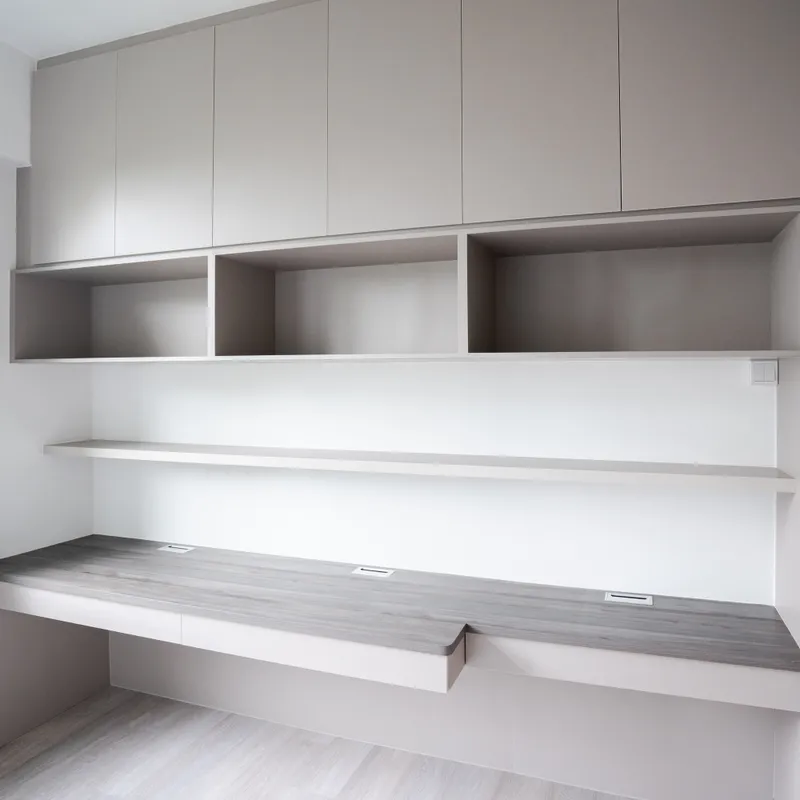
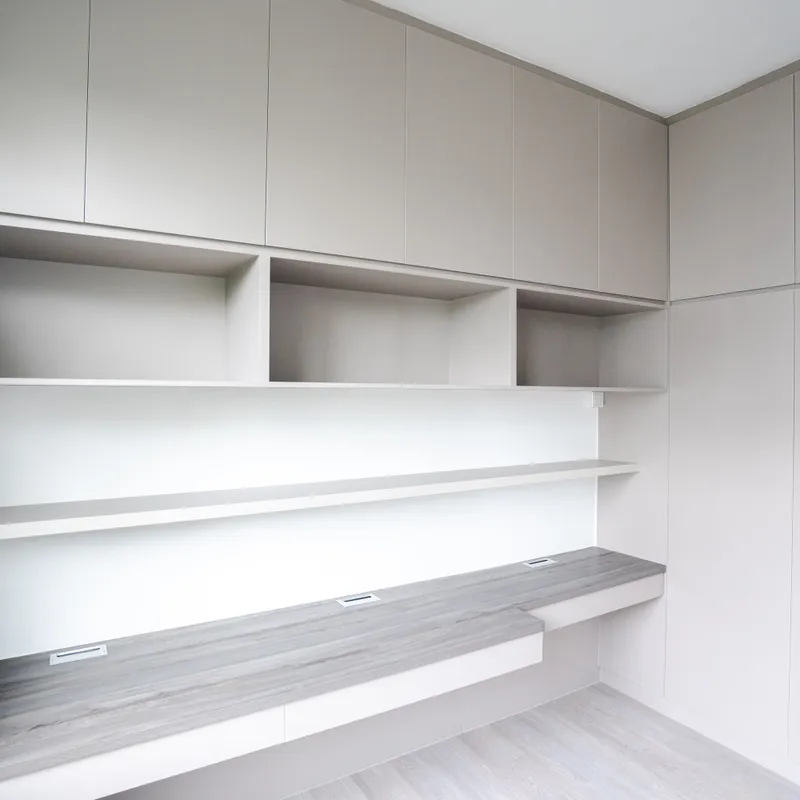
A floating desk in wood-grain laminate (the only place wood-grain appears in the build) with overhead cubby shelving and full-height wall cabinets matching the cream vocabulary. The desk wraps a corner without visible fixings — the structural mounting is internal to the wall.
The wood-grain laminate on the desk top is the build's only break from the cream-matte rule. It's a deliberate exception: the desk needs to read as a working surface, not as more cabinetry. A warmer material at the working level reinforces that.
Above the desk: three open cubbies for daily-use items (pens, headphones, a single book), then closed wall cabinets up to ceiling. The composition reads as designed rather than improvised, which is harder than it looks on a working desk.
The bedroom feature
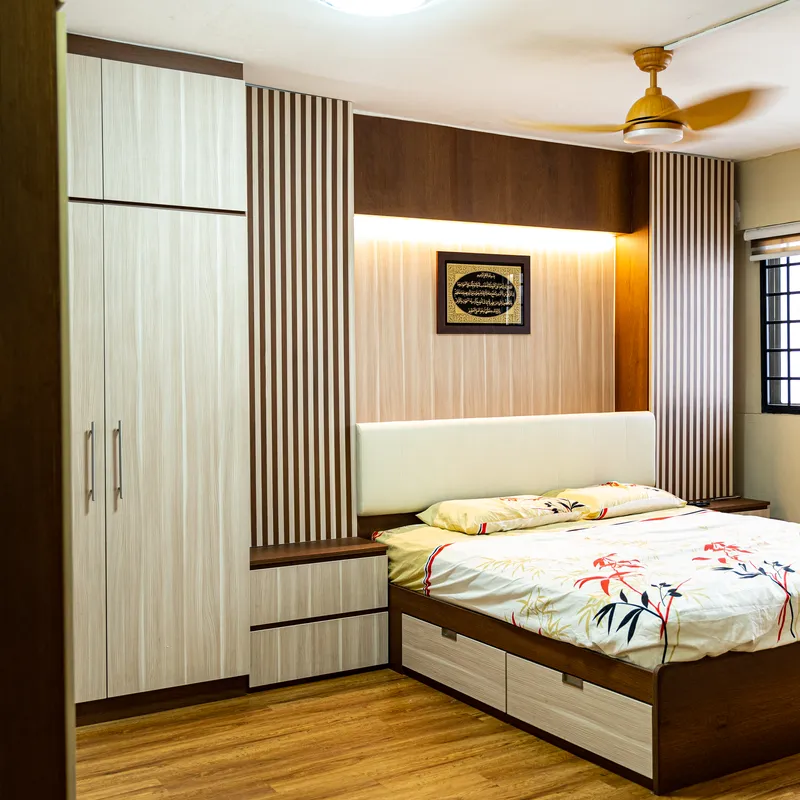
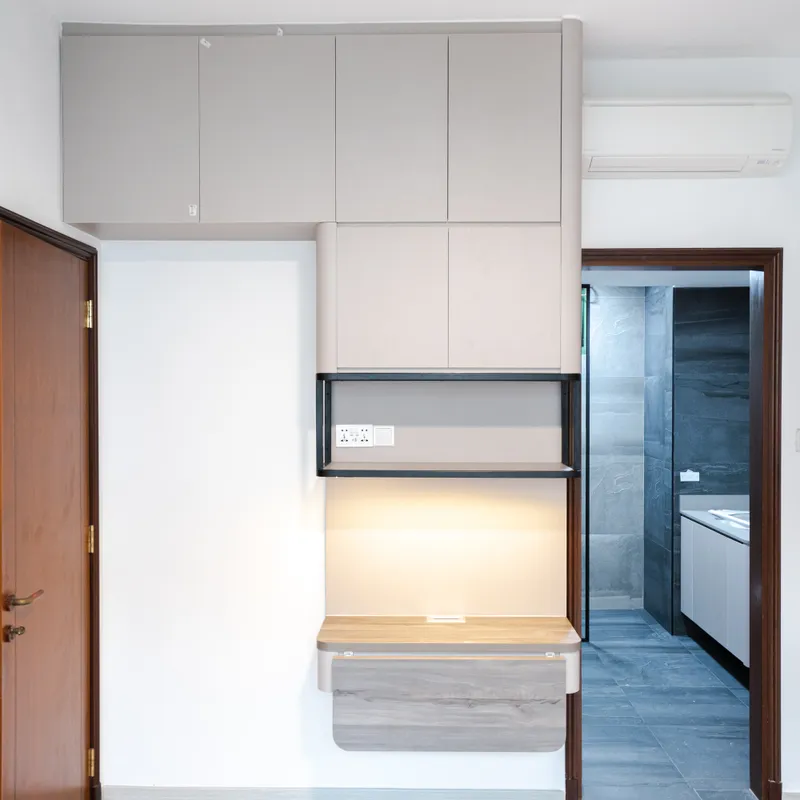
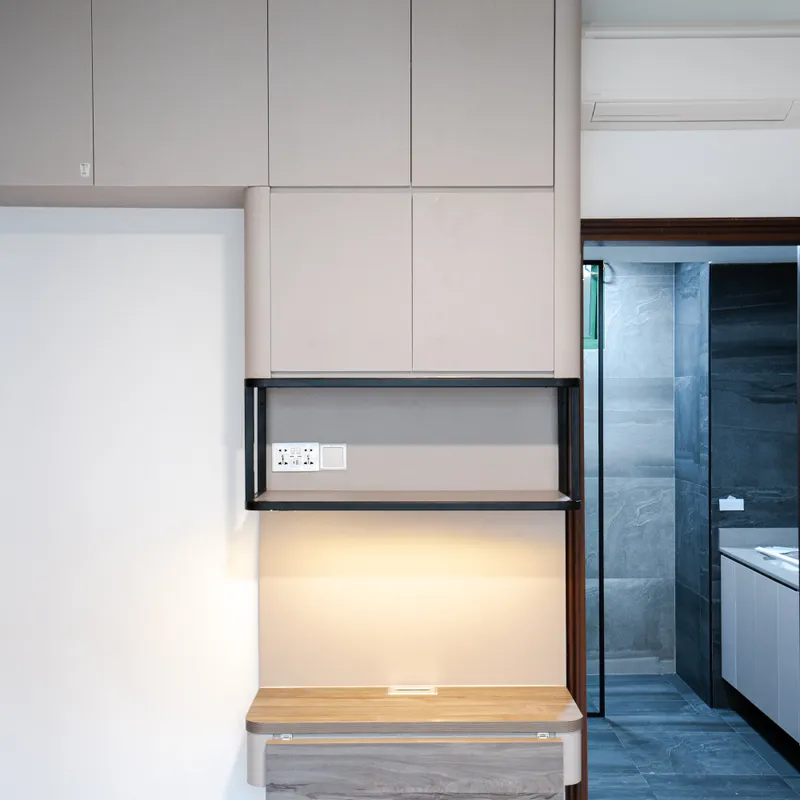
The piece that ties back to the master wardrobe. Overhead cabinets in cream matte, a black-framed open shelf below them, a floating wood ledge beneath that, and concealed warm-LED illuminating the ledge from above.
The black frame around the open shelf is the same vocabulary as the wardrobe's glass display tower — same matte black, same powder-coat finish. Walking from the master wardrobe to the bedroom, you encounter the design language twice. It reads as deliberate continuity rather than coincidence.
The warm LED matters here. It's not bright. It's the kind of light that disappears in daylight and becomes the focal point at night. The floating wood ledge below it picks up the warmth and reads as a quietly-lit shelf rather than a piece of cabinetry.
Materials and craft
- Carcass: 18mm moisture-resistant plywood throughout — Singapore humidity is non-negotiable for any indoor cabinetry
- Fronts (visible): cream matte laminate, single tone across all cabinetry except the study desk top
- Study desk top: wood-grain laminate (the build's only intentional break from cream)
- Accent frames: black powder-coated steel around glass display column + open shelf
- Kitchen surfaces: grey textured stone, backsplash and matching counter
- Bedroom feature ledge: light wood-grain laminate
- Edge banding: hot-melt PVC, all four sides of every panel
- Hardware: Blum soft-close throughout — hinges, drawer runners
- Lighting: concealed warm-LED 2700K under the bedroom feature's overhead cabinets
Process
Multi-room build, sequenced on-site install. The kitchen's stone components received their own delivery window separate from the laminated cabinetry — different trades, different tolerances, different scribe approaches. The black-framed metalwork (wardrobe display column + bedroom open shelf) was a separate fabrication run; the install team handled the integration with the surrounding cream laminate carpentry on site.
The hardest moment in a build like this is where the cream meets the black frame. Both finishes have to be set so neither dominates — too proud a frame and the wardrobe reads as a display unit with cabinetry stuck to it; too recessed a frame and the display column disappears. The right tolerance is somewhere within a millimetre.
Cost range
A multi-room residential carpentry build at this material standard — cream matte across four rooms, integrated stone, custom metalwork accents in two rooms, concealed warm-LED integration — typically falls in the S$25,000–S$45,000 range. The variables are total linear footage, the proportion of accent metalwork vs standard cabinetry, and whether stone is used in only the kitchen or also elsewhere.
What to take from this build
Restraint scales. A single restrained vocabulary running across four rooms produces a build that reads as one project rather than four separate jobs. The decisions are subtractive: which finish, which accent, which contrast — and then everything else has to obey those decisions, even when individual rooms might have benefited from breaking them.
The black-framed glass element repeating across the wardrobe and the bedroom feature is the move that does the work. It's small enough to feel quiet, repeated often enough to feel deliberate.
Where to go from here
Want a restrained multi-room build in your own home? WhatsApp Alan with your floor plan and reference photos of the look.
For broader pricing context across all property types, see the pricing page. For the materials side, the plywood vs blockboard vs MDF guide explains what's inside every cabinet. For the laminate-vs-veneer-vs-lacquer decision, see choosing laminate for kitchen cabinets in Singapore's humidity.
Photographs
More from this build.
Want a build like this?
Real quote within 24 hours.
WhatsApp Alan with your floor plan and a few reference photos. Site visit and quote are free, no deposit until you sign off on the 3D mock-up.