Condominium · Compassvale
Compassvale Condominium — One Walnut Wall Doing the Work of a Room
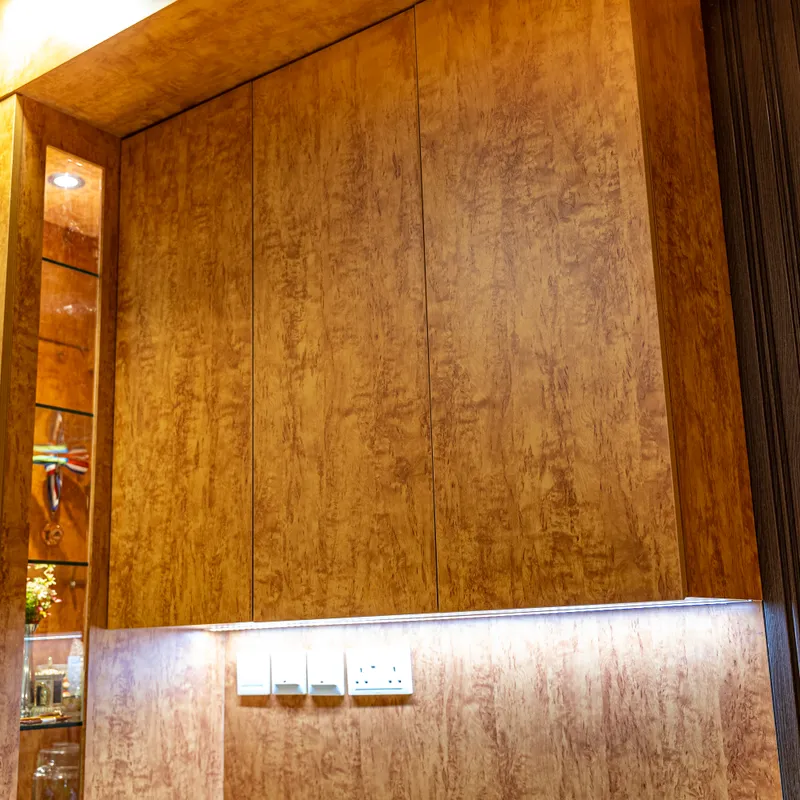
Bookmatched walnut veneer, a black-framed glass display column standing full height, a vertical fluted accent in dark timber, a sage stone counter washed by concealed warm LED. One architectural move; everything else gets to be quiet.
Statement feature wall · Workshop fabrication; MCST-coordinated install · Indicative range S$5k–S$15k
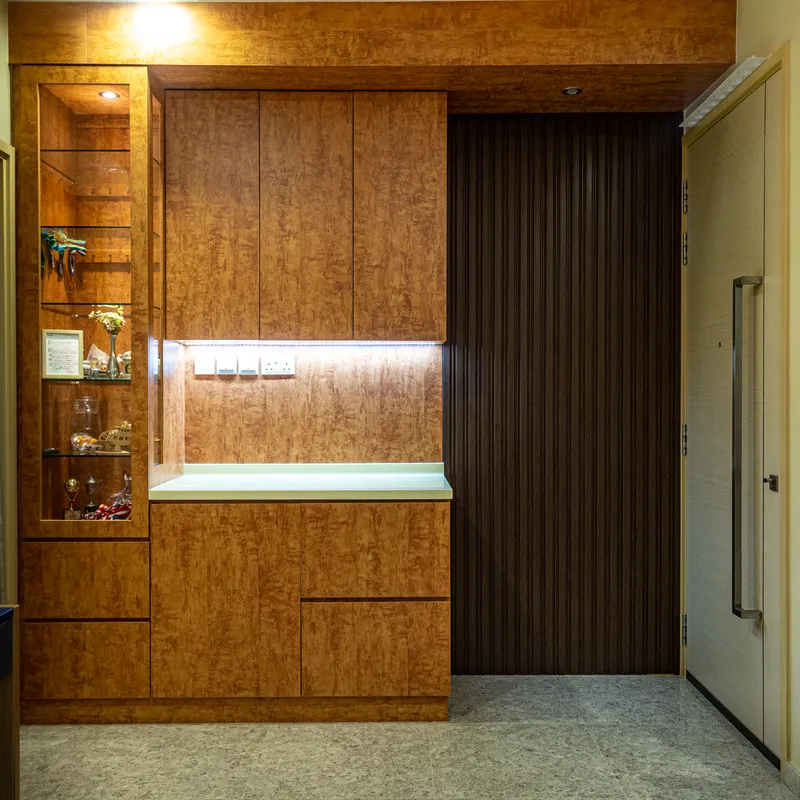
Warm walnut veneer statement wall with integrated black-framed glass display column — Compassvale condominium
The design idea: one wall does the work of a whole room.
A condominium often gives you one architectural surface that defines how the room reads — the wall opposite the entry, the wall behind the dining table, the wall the sofa points at. Treating that wall as a single composed piece, rather than as a place to hang individual cabinets, is the choice this project rests on.
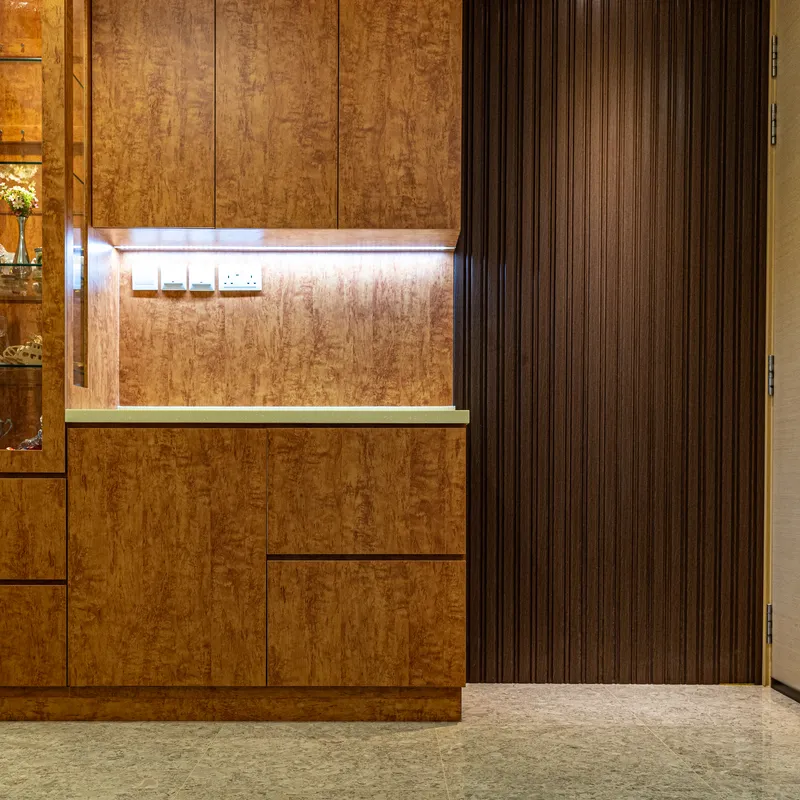
What lives on it is four elements working as one composition: bookmatched walnut veneer cabinetry, a vertical fluted accent panel in darker timber, a black-framed glass display column standing full height, and a sage-green stone counter washed by concealed warm LED. Everything else in the room gets to be quiet.
The walnut veneer
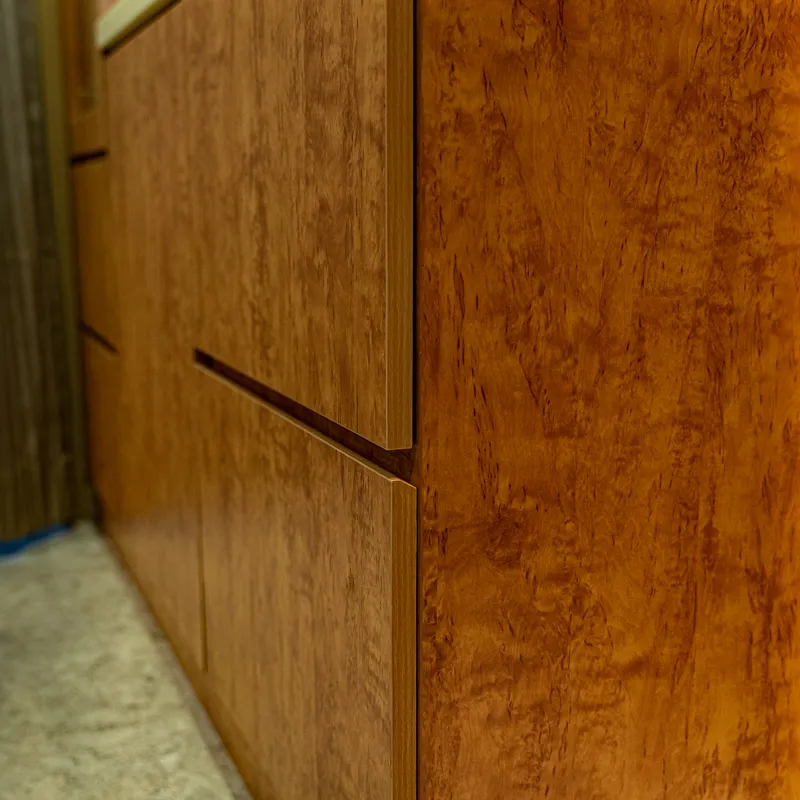
Real wood, sliced thin and laid over a structural plywood core. The fronts are bookmatched — adjacent panels mirror each other along the seam, so the grain pattern reads as a continuous flowing surface rather than a set of independent doors. It's a specific workshop choice; off-the-shelf doors don't come bookmatched.
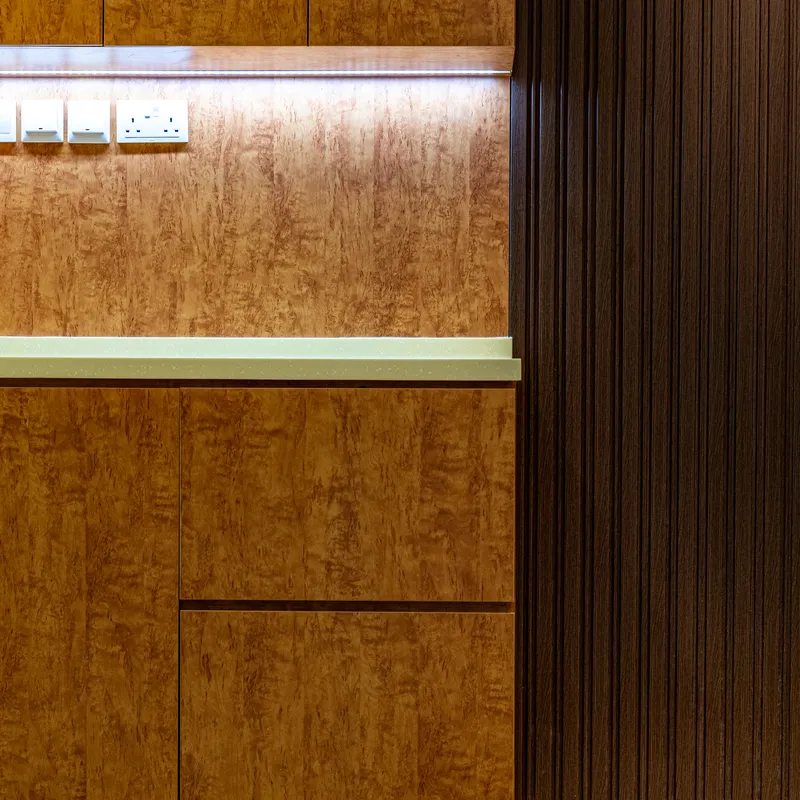
The tone is warm — somewhere between honey and amber, with the burl-like figuring that catches light differently as you move past it. In daylight the wall reads as a coherent warm field. Under the concealed LED at night, the figuring becomes the room's main visual texture.
Bookmatching also gives the workshop an opportunity to show its hand — the seam between two matched panels has to be set with the grain registration right, and the edges have to meet without a visible gap. This wall passes both tests.
The black-framed glass display column
The standout element. A vertical column of glass shelves framed in black powder-coated steel, standing at full ceiling height against the walnut. It does three things at once:
- It breaks the wall's continuity at exactly the right point — without the column, the walnut would read as a single uninterrupted slab. The column inserts a vertical pause.
- It introduces a second material vocabulary — the dark steel frame and the transparent glass shelves create a colour and texture contrast against the warm wood.
- It offers usable display. Ceramics, books, small collected objects, candles — items the household wanted visible rather than stored. The glass keeps dust off; the depth gives them room to sit.
The frame is slim enough not to compete with the wood, dark enough to anchor it. Without the column, the wall would be too warm; with it, the warmth has a counterweight.
The vertical fluted accent
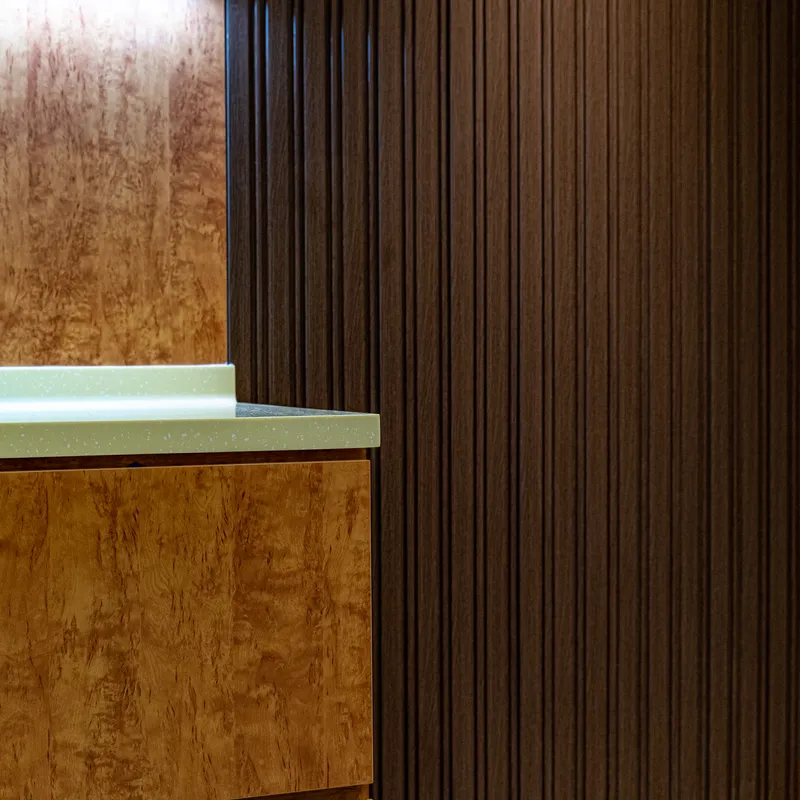
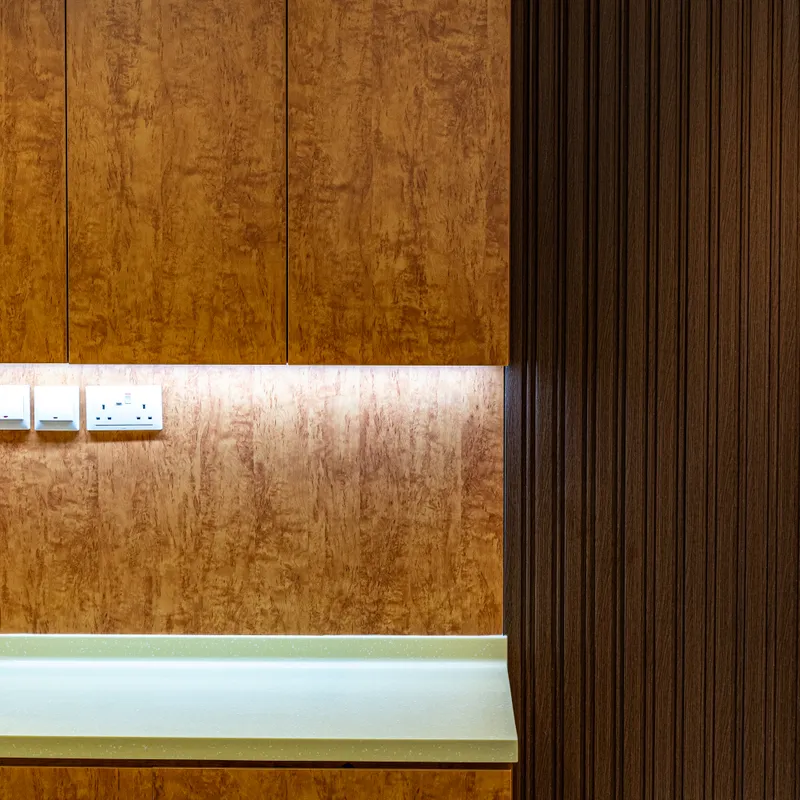
To one side of the walnut cabinetry, a vertical fluted panel in dark timber runs floor to ceiling. The fluting picks up the same vertical rhythm as the glass display column, but in a closed wood form rather than an open metal frame. It's the bridge between the two materials — wood and steel — and it gives the wall composition a quiet third texture.
Look at where the walnut meets the fluted panel: the join is clean, the depths register flush, the colours sit deliberately against each other rather than competing.
The sage stone counter
A length of sage-green stone surface runs horizontally across the centre of the composition. It acts as a visual band — splitting the wall into upper and lower zones, giving the eye a horizontal anchor against all the vertical movement.
It's usable too: a place to set down keys, a vase, a tray. The depth is generous enough to be functional, narrow enough not to dominate.
The concealed LED
Warm 2700K under the upper cabinets, washing down onto the sage counter and the open centre cubby. Two things this does well:
- It turns the counter into a soft horizontal glow at night, rather than letting it disappear into the wall once room lights are off.
- It makes the open cubby feel like a display niche rather than a void in the wall. Anything you set in the cubby reads as intentional, lit, placed.
The light is concealed completely — no visible fitting, just the warmth itself. Standard workshop practice for this kind of feature wall, but the effect lands.
Materials and craft
- Carcass: 18mm moisture-resistant plywood (the visible walnut is a veneer face over plywood — non-negotiable for Singapore humidity)
- Visible fronts: warm walnut veneer with bookmatched grain across the larger panels
- Accent panel: vertical fluted timber in a darker tone
- Counter: sage-green stone surface, integrated into the cabinetry
- Display frame: black powder-coated steel around vertical glass shelves
- Edge banding: hot-melt PVC, colour-matched
- Hardware: Blum soft-close throughout
- Lighting: concealed warm-LED 2700K, washing the sage counter from above
Process
Workshop fabrication at our Eunos workshop. MCST coordination handled lift padding and the weekday delivery window for the condominium. The trickiest install moment is where the walnut, the fluted accent panel, and the glass-framed column all converge — the tolerances at that meeting point determine whether the wall reads as composed or assembled.
Cost range
A feature wall at this material standard — bookmatched veneer, integrated stone, metalwork frame, concealed lighting, multiple closely-coordinated material transitions — typically falls in the S$5,000–S$15,000 range depending on overall width, stone choice, and the complexity of the metalwork detail. Smaller versions (display column alone, or wall cabinetry without the stone band) sit at the lower end.
What to take from this build
You don't have to build out a whole room to give it identity. One wall, treated as a single composed piece, can do more work than three rooms of distributed carpentry.
The discipline is restraint: pick a primary material (walnut), an accent (dark fluting), a contrast element (glass and steel), one secondary surface (sage stone), and one source of warmth (concealed LED). Five decisions, executed precisely, hold the room.
Where to go from here
Want a statement wall in your own home? WhatsApp Alan with your floor plan and a few reference photos of the look you want.
For broader pricing context, see the pricing page. For the materials side, the plywood vs blockboard vs MDF guide covers what sits behind every veneer face. For the visible-surface conversation (laminate vs veneer vs lacquer), see choosing laminate for kitchen cabinets in Singapore's humidity.
Photographs
More from this build.
Want a build like this?
Real quote within 24 hours.
WhatsApp Alan with your floor plan and a few reference photos. Site visit and quote are free, no deposit until you sign off on the 3D mock-up.